"Protecting that which our clients treasure most … Everything they own and everyone they love"
Contact Ronald C. Morton, J.D., LL.M., CELA | (601)925-9797 | Representing Families Throughout Mississippi
Schedule a Call
Fill in your details below and we'll have one of our product specialists contact you.
Your Trust
A revocable living trust is a legal arrangement through which one person (or an institution, such as a bank or law firm), called a “trustee,” holds legal title to property for another person, called a “beneficiary.”
The rules or instructions under which the trustee operates are set out in the trust instrument. Trusts have one set of beneficiaries during their lives and another set — often their children — who begin to benefit only after the first group has died. The first are often called “life beneficiaries” and the second “remaindermen.” (For an overview of a trustee’s duties, click here.)
Uses of Trusts
There can be several advantages to establishing a trust, depending on your situation. Best-known is the advantage of avoiding probate. In a trust that terminates with the death of the donor, any property in the trust prior to the donor’s death passes immediately to the beneficiaries by the terms of the trust without requiring probate. This can save time and money for the beneficiaries. Certain trusts can also result in tax advantages both for the donor and the beneficiary. These are often referred to as “credit shelter” or “life insurance” trusts. Other trusts may be used to protect property from creditors or to help the donor qualify for Medicaid.
Unlike wills, trusts are private documents and only those individuals with a direct interest in the trust need know of trust assets and distribution. Provided they are well-drafted, another advantage of trusts is their continuing effectiveness even if the donor dies or becomes incapacitated.
Kinds of Trusts
Trusts fall into two basic categories: testamentary and inter vivos.
- A testamentary trust is one created by your will, and it does not come into existence until you die. In contrast, an inter vivos trust starts during your lifetime. You create it now and it exists during your life.
- There are two kinds of inter vivos trusts: revocable and irrevocable.
Revocable Trusts
Revocable trusts are often referred to as “living” trusts. With a revocable trust, the donor maintains complete control over the trust and may amend, revoke or terminate the trust at any time. This means that you, the donor, can take back the funds you put in the trust or change the trust’s terms. Thus, the donor is able to reap the benefits of the trust arrangement while maintaining the ability to change the trust at any time prior to death.
Revocable trusts are generally used for the following purposes:
- Asset management. They permit the named trustee to administer and invest the trust property for the benefit of one or more beneficiaries.
- Probate avoidance. At the death of the person who created the trust, the “grantor” or “donor,” the trust property passes to whoever is named in the trust. It does not come under the jurisdiction of the probate court and its distribution need not be held up by the probate process. However, the property of a revocable trust will be included in the grantor’s estate for tax purposes.
- Tax planning. While the assets of a revocable trust will be included in the grantor’s taxable estate, the trust can be drafted so that the assets will not be included in the estates of the beneficiaries, thus avoiding taxes when the beneficiaries die.
Revocable Trusts
An irrevocable trust cannot be changed or amended by the donor. Any property placed into the trust may only be distributed by the trustee as provided for in the trust document itself. For instance, the donor may set up a trust under which he or she will receive income earned on the trust property, but that bars access to the trust principal. This type of irrevocable trust is a popular tool for Medicaid planning.
Testamentary Trusts
As noted above, a testamentary trust is a trust created by a will. Such a trust has no power or effect until the will of the donor is probated. Although a testamentary trust will not avoid the need for probate and will become a public document as it is a part of the will, it can be useful in accomplishing other estate planning goals. For instance, the testamentary trust can be used to reduce estate taxes on the death of a spouse or provide for the care of a disabled child.
Supplemental Needs Trusts
The purpose of a supplemental needs trust is to enable the donor to provide for the continuing care of a disabled spouse, child, relative or friend. The beneficiary of a well-drafted supplemental needs trust will have access to the trust assets for purposes other than those provided by public benefits programs. In this way, the beneficiary will not lose eligibility for benefits such as Supplemental Security Income, Medicaid and low-income housing. A supplemental needs trust can be created by the donor during life or be part of a will.
Credit Shelter Trusts
Credit shelter trusts are a way to take full advantage of the estate tax exemption.The first $2 million (in 2006) of an estate are exempt from taxes, so theoretically a husband and wife would have no estate tax if their estate is less than $4 million. However, if one spouse dies and leaves everything to the surviving spouse, the surviving spouse may have an estate that is greater than $2 million. When the surviving spouse dies, any part of the estate over $2 million will be subject to estate tax.
To avoid this problem, the spouses can create a credit shelter trust as part of their estate plan. When one spouse passes away, the first $2 million of that spouse’s estate is put in to a trust. The surviving spouse can receive income from the trust, but as long as he or she does not control the principal, the money will not be included in the surviving spouse’s estate when he or she passes away.
I'm Here Because...

Protection from Medicaid
I want to protect my parent's House and Money from Medicaid and Nursing Home costs.

Protection from Lawsuits
I want my Legacy Protected from Creditors, Lawsuits, Divorce, Remarriage, Medicaid Nursing home taxes and Probates.

Qualify for Aid
I want to qualify for VA Aid and Attendance benefits to help pay for in-home care assisted living and nursing home.
Affiliation & Accreditation

.png)
How to Work with Us
Our firm has a 3 step process to help you move from "I'll get around to it" to "I'm Finished!" It begins with a phone call where, together, we determine whether our firm can help. If we are a good fit, you will have the opportunity to schedule an in -person meeting. If not, we will refer you to someone who can help. Either way, you will be on your way to solving your problem. It begins with clicking the button and scheduling a call. Would you like to see how Morton Law Firm can help you?
Morton Law Firm, PLLC
"Protecting that which our clients treasure most... Everything they own, and everyone they love."
What Makes Us Different?

Were you told not to bother applying for the Aid & Attendance Special Pension Benefit for Wartime Veterans because “no one ever gets approved?” Our firm’s 5 step process has been qualifying veterans and their widowed spouses for this valuable benefit for over a decade.

Worried about how your child with special needs will get proper care when you are no longer available to help? Our firm helps families provide financially for their special needs children without costing them their government benefits.

Our firm has a 5-step process to ensure that all the details of your loved one’s estate are handled with a minimum of delay. When it comes to Mississippi Probate, we literally wrote the book.

Other firms practice “Elder Law” as one of a dozen other unrelated practice areas without any recognized specialization. Our firm knows how to qualify people for public benefits while protecting as much of what’s theirs as the law allows, and we have the certifications and credentials to prove it. It’s what we do … It’s the only thing we do.
"My experience was unexpectedly easier than I imagined. It was very efficient with timely results. I have recommended your service to several close friends. I was that confident and pleased with my results. Unfortunately, I needed to use your help after the sudden passing of my wife in late 2013. Your help was invaluable. Thank you for your kind assistance."
Charles P
"Mr. Morton and all of his associates were so professional and friendly each time I had to call them and also when I saw them in person. I would highly recommend their services."
Janice D
"Thank you for your excellent service to my family. It is wonderful to have such a trustworthy, efficient, and courteous firm looking after our legal needs. You and all of your employees are very responsive and skillful. Thanks Mr. Morton for assembling such a wonderful team."
Shirley T
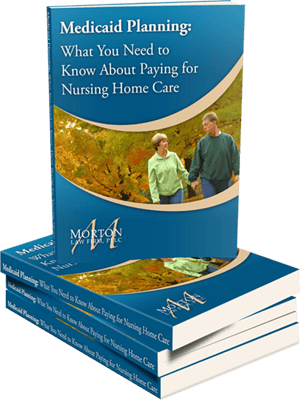
Get Your FREE Report Now!
Three Reports Tell Secrets to Paying for Nursing Home Care.
Simply enter your name and email to the right to get your 3 Free Reports that reveal little known secrets to qualifying for Medicaid without going broke.
Plus, receive the Morton Law Firm email newsletter and alerts to upcoming education events absolutely free!