"Protecting that which our clients treasure most … Everything they own and everyone they love"
Contact Ronald C. Morton, J.D., LL.M., CELA | (601)925-9797 | Representing Families Throughout Mississippi
Schedule a Call
Fill in your details below and we'll have one of our product specialists contact you.
Family Heritage Trust

The primary motivation for most people in planning their estates is the protection of their family. There are great benefits that come with planning to ensure that your estate is distributed the way that you desire and to the people that you choose. This excerpt will discuss some specific strategies that will not only transfer your assets as you wish but will also protect and preserve your legacy for future generations.
One common option in providing for spouses is a simple outright distribution of the entire estate to the spouse. While this is certainly an acceptable option, you should give some consideration to the possibility of your spouse’s remarriage or potential long-term care needs after your death. Additionally, if you have children from a previous marriage, you will likely want to provide for the comfort and well-being of your spouse during his or her remaining lifetime while also providing some protections for your children upon your spouse’s death. You certainly would not want your children accidentally disinherited because you died first and your spouse remarried. Similarly, you may desire to divide your estate among your children, but have concerns that they may squander the estate frivolously or lose it in a divorce. Solutions for addressing each of those concerns will be explored in the following paragraphs.
Because of increasingly higher exemptions, the threat of estate taxes on an estate is exceedingly rare. However for estates valued greater than $5 million, some planning for possible estate taxes is still necessary. Currently, there is no Mississippi estate or inheritance tax; however, the federal government has imposed a death tax of approximately 45% of the value of any assets exceeding $11.2 million. That tax threshold is scheduled to be reduced to $5.49 million effective January 1, 2026, unless Congress takes some intervening action before the sunset of the existing tax law. Accordingly, if you have a large estate, there are certain additional planning opportunities that can effectively double the existing applicable estate tax exemption. This tax minimization is accomplished through use of the tax exemption credit for each spouse. In other words, each spouse is entitled to use their own exemption.
At the death of the first spouse, the estate can split assets. The maximum value of the exemption amount can be placed within a Family Trust in order to fully utilize the applicable exemption credit belonging to the first spouse to die. The remainder of the estate can be paid into a Marital Trust which would qualify for an unlimited marital deduction. Thus, there would be no tax incurred at the time of the deceased spouse’s death regardless of estate value. The assets in both the Family Trust and the Marital Trust can be made available to the surviving spouse so as to provide for that surviving spouse’s care and support. However, upon the death of the surviving spouse, the assets contained in the Family Trust would pass outside the surviving spouse’s taxable estate. The assets in the Marital Trust would be counted in that spouse’s estate, but would also be subject to that spouse’s separate exemption. Accordingly, for use of this marital planning, an estate exemption can be doubled and passed to the children or other named beneficiaries free of any estate tax. An alternative approach would be to file a tax return upon the death of the first spouse and “port” over that spouse’s exemption to the survivor. Planning of this nature is extremely complicated and requires significant forethought, but the potential tax savings in large estates makes the effort worthwhile.
With nearly half of all marriages ending in a divorce, it is not unusual for an estate to involve a second marriage, as well as children on either side from the prior marriage. Similarly, it is not uncommon for a surviving spouse to remarry upon the death of the first spouse. These circumstances require careful planning.
If you have children from a prior marriage, you are likely to be torn between your desire to protect and provide for your surviving spouse’s well-being and ensuring your children (not your spouse’s children) receive the remainder of your estate. These goals can best be accomplished through the use of a trust created for the benefit of the surviving spouse. We frequently refer to this type of trust as a “Family Heritage Trust™.”
A Family Heritage Trust™ can either be a Testamentary Trust or contained within a Revocable Living Trust. Such trusts usually provide that the assets placed within the trust are available for the benefit of a surviving spouse, but upon the death of that spouse, the assets are distributed to named beneficiaries. Frequently, the surviving spouse is named as trustee of that trust. On other occasions, one or more of the children are appointed as trustee, or, appointed to serve alongside the surviving spouse as co-trustees. Sometimes a surviving spouse is named sole trustee, but if that spouse remarries their children are then named as co-trustees. Institutions such as trust companies or banks are also appropriate to name as trustees.
The surviving spouse’s access to the trust assets may be unlimited; however, this would usually defeat the purpose of the trust. The overall purpose of the trust is to provide for the deceased spouse’s children as well as the surviving spouse. Unlimited access would give the surviving spouse the opportunity to invade the trust and distribute the assets upon that spouse’s death to that spouse’s beneficiaries. A more common approach is to give the surviving spouse all of the income from the family trust with limited access to principal for such things as the surviving spouse’s health, or general support needs. This effectively gives the surviving spouse all of the excess that he or she requires but only for legitimate purposes. This would not permit the trust to be raided for an inappropriate purpose such as transfers to the surviving spouse’s new spouse or transfers to step-children.
The Heritage Trust™ can serve to protect your children from your spouse’s remarriage while simultaneously providing for the needs of your surviving spouse. Just as importantly, the Heritage Trust™ can also protect your surviving spouse from potential predators those that might prey on a surviving widow for their own selfish purposes. The assets of the trust would not be available, for example, to your surviving spouse’s new spouse, should he or she choose to remarry after your death. Similarly, if the trust is drafted properly, the trust assets can be made unavailable to your spouse for purposes of public benefit computations. In that manner, the trust assets would not be required to be spent on long-term care benefits for the surviving spouse but could be available for the spouse’s supplemental needs. Likewise, a properly drafted Family Heritage Trust™ can provide protection from a surviving spouse’s separate creditors. All of these provisions serve to both provide for the surviving spouse of the marriage yet protect the assets for the children of that marriage or a prior marriage.
I'm Here Because...

Protection from Medicaid
I want to protect my parent's House and Money from Medicaid and Nursing Home costs.

Protection from Lawsuits
I want my Legacy Protected from Creditors, Lawsuits, Divorce, Remarriage, Medicaid Nursing home taxes and Probates.

Qualify for Aid
I want to qualify for VA Aid and Attendance benefits to help pay for in-home care assisted living and nursing home.
Affiliation & Accreditation

.png)
How to Work with Us
Our firm has a 3 step process to help you move from "I'll get around to it" to "I'm Finished!" It begins with a phone call where, together, we determine whether our firm can help. If we are a good fit, you will have the opportunity to schedule an in -person meeting. If not, we will refer you to someone who can help. Either way, you will be on your way to solving your problem. It begins with clicking the button and scheduling a call. Would you like to see how Morton Law Firm can help you?
Morton Law Firm, PLLC
"Protecting that which our clients treasure most... Everything they own, and everyone they love."
What Makes Us Different?

Were you told not to bother applying for the Aid & Attendance Special Pension Benefit for Wartime Veterans because “no one ever gets approved?” Our firm’s 5 step process has been qualifying veterans and their widowed spouses for this valuable benefit for over a decade.

Worried about how your child with special needs will get proper care when you are no longer available to help? Our firm helps families provide financially for their special needs children without costing them their government benefits.

Our firm has a 5-step process to ensure that all the details of your loved one’s estate are handled with a minimum of delay. When it comes to Mississippi Probate, we literally wrote the book.

Other firms practice “Elder Law” as one of a dozen other unrelated practice areas without any recognized specialization. Our firm knows how to qualify people for public benefits while protecting as much of what’s theirs as the law allows, and we have the certifications and credentials to prove it. It’s what we do … It’s the only thing we do.
"My experience was unexpectedly easier than I imagined. It was very efficient with timely results. I have recommended your service to several close friends. I was that confident and pleased with my results. Unfortunately, I needed to use your help after the sudden passing of my wife in late 2013. Your help was invaluable. Thank you for your kind assistance."
Charles P
"Mr. Morton and all of his associates were so professional and friendly each time I had to call them and also when I saw them in person. I would highly recommend their services."
Janice D
"Thank you for your excellent service to my family. It is wonderful to have such a trustworthy, efficient, and courteous firm looking after our legal needs. You and all of your employees are very responsive and skillful. Thanks Mr. Morton for assembling such a wonderful team."
Shirley T
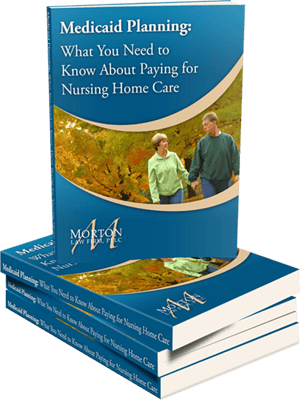
Get Your FREE Report Now!
Three Reports Tell Secrets to Paying for Nursing Home Care.
Simply enter your name and email to the right to get your 3 Free Reports that reveal little known secrets to qualifying for Medicaid without going broke.
Plus, receive the Morton Law Firm email newsletter and alerts to upcoming education events absolutely free!