"Protecting that which our clients treasure most … Everything they own and everyone they love"
Contact Ronald C. Morton, J.D., LL.M., CELA | (601)925-9797 | Representing Families Throughout Mississippi
Schedule a Call
Fill in your details below and we'll have one of our product specialists contact you.
Making Gifts: The $10,000 Rule
One simple way you can reduce estate taxes or shelter assets in order to achieve Medicaid eligibility is to give some or all of your estate to your children (or anyone else) during their lives in the form of gifts. Certain rules apply, however. There is no actual limit on how much you may give during your lifetime. But if you give any individual more than $15,000 (in 2018), you must file a gift tax return reporting the gift to the IRS. Also, the amount above $15,000 will be counted against a lifetime tax exclusion for gifts. This exclusion was $1 million for many years but is now $11.2 million (in 2018). Each dollar of gift above that threshold reduces the amount that can be transferred tax-free in your estate.
The $15,000 figure is an exclusion from the gift tax reporting requirement. You may give $15,000 to each of your children, their spouses, and your grandchildren (or to anyone else you choose) each year without reporting these gifts to the IRS. In addition, if you’re married, your spouse can duplicate these gifts. For example, a married couple with four children could give away up to $120,000 to their children in 2018 with no gift tax implications. In addition, the gifts will not count as taxable income to your children (although the earnings on the gifts, if they are invested, will be taxed).
5 Questions to Ask Before Making Gifts for Medicaid or Tax Planning
Many seniors consider transferring assets for estate and long-term care planning purposes, or just to help out children and grandchildren. Gifts and transfers to a trust often make a lot of sense. They can save money in taxes and long-term care expenditures, and they can help out family members in need and serve as expressions of love and caring.
But some gifts can cause problems, for both the generous donor and the recipient. Following are a few questions to ask yourself before writing the check:
Why are you making the gift? Is it simply an expression of love on a birthday or big event, such as a graduation or wedding? Or is it for tax planning or long-term care planning purposes? If the latter, make sure that there’s really a benefit to the transfer. If the value of your assets totals less than the estate tax threshold in your state, your estate will pay no tax in any case. For federal purposes the threshold is $11.2 million (in 2018). Gifts can also cause up to five years of ineligibility for Medicaid, which you may need to help pay long-term care costs.
Are you keeping enough money? If you’re making small gifts, you might not need to worry about this question. But before making any large gifts, it makes sense to do some budgeting to make sure that you will not run short of funds for your basic needs, activities you enjoy — whether that’s traveling, taking courses or going out to eat — and emergencies such as the need for care for yourself or to assist someone in financial trouble.
Is it really a gift (part one)? Are you expecting the money to be paid back or for the recipient to perform some task for you? In either case, make sure that the beneficiary of your generosity is on the same page as you. The best way to do this is in writing, with a promissory note in the case of a loan or an agreement if you have an expectation that certain tasks will be performed.
Is it really a gift? Another way a gift may not really be a gift is if you expect the recipient to hold the funds for you (or for someone else, such as a disabled child) or to let you live in or use a house that you have transferred. These are gifts with strings attached, at least in theory. But if you don’t use a trust or, in the case of real estate, a life estate, legally there are no strings attached. Your expectations may not pan out if the recipient doesn’t do what you want or runs into circumstances — bankruptcy, a lawsuit, divorce, illness — that no one anticipated. If the idea is to make the gifts with strings attached, it’s best to attach those strings legally through a trust or life estate.
Is the gift good for the recipient? If the recipient has special needs, the funds could make her ineligible for various public benefits, such as Medicaid, Supplemental Security Income or subsidized housing. If you make many gifts to the same person, you may help create a dependency that interferes with the recipient learning to stand on his own two feet. If the recipient has issues with drugs or alcohol, he may use the gifted funds to further the habit. You may need to permit the individual to hit bottom in order to learn to live on his own (i.e., don’t be an “enabler”).
If after you’ve answered all of these questions, you still want to make a gift, please go ahead. But unless the gift is for a nominal amount, it is advisable to check with your attorney to make sure you are aware of the Medicaid, tax and other possible implications of your generosity.
Gifts to Grandchildren
Gifting assets to your grandchildren can do more than help your descendants get a good start in life; it can also reduce the size of your estate and the tax that will be due upon your death.
Perhaps the simplest approach to gifting is to give the grandchild an outright gift. You may give each grandchild up to $15,000 a year (in 2018) without having to report the gifts. If you’re married, both you and your spouse can make such gifts. For example, a married couple with four grandchildren may give away up to $120,000 a year with no gift tax implications. In addition, the gifts will not count as taxable income to your grandchildren (although the earnings on the gifts if they are invested will be taxed). Just remember that any gift can interfere with Medicaid eligibility. But you may have some misgivings about making outright gifts to your grandchildren. There is no guarantee that the money will be used in the way you may have wished. Money that you hoped would be saved for educational expenses may instead be spent on a fact-finding mission to Fort Lauderdale. Fortunately, there are a number of options to protect against misuse of the funds by grandchildren:
You can pay for educational and medical costs for your grandchildren. There’s no limit on these gifts, meaning that you can pay these expenses in addition to making annual $15,000 (in 2018) gifts. But you have to be sure to pay the school or medical provider directly.
You can make gifts to a custodial account that parents can establish for a minor child.
You can transfer money into a trust established to benefit a grandchild.
You can reduce your taxable estate while earmarking funds for the higher education of a grandchild through the use of a “529 account.”
You can use other gift vehicles like IRAs and savings bonds.
Gifts to Grandchildren: Gift Trusts
There are some serious drawbacks to many options for giving gifts to grandchildren. Either there are no tax or estate planning advantages, or you have no control of the funds (or lose control after a certain point), or the money could affect a grandchild’s eligibility for financial aid. An option that overcomes many of these problems involves transferring money into a trust established to benefit a grandchild. With the help of an attorney, you can draft a trust that reflects your express wishes about when the income and principal will be available to the grandchild, and even how the funds will be spent.
Transferring funds into such a trust offers the following benefits:
- You can reduce the size of your estate by transferring up to $15,000 (in 2018) into each trust you create for each grandchild. No gift taxes will be due in connection with the transfers;
- Although the trust owns the assets, you control them as trustee and can decide what type of investments to make;
- Income earned by the trust from amounts that you’ve deposited will not be taxed to you; the trust pays the taxes;
- Amounts deposited in trust, and the income earned from those funds, will be used for the benefit of your grandchildren; and
- You can provide that the trust terminate at any age you specify.
In order to qualify for these benefits, however, certain restrictions apply. These trusts are complex legal documents and should not be set up without the help of an experienced attorney. As a result, the chief downside of such trusts is the cost of establishing and maintaining them, which you should discuss with an attorney before going ahead with a trust.
Finally, you must be totally comfortable with this gift-planning strategy and the amount of money available to you in your estate. In short, you should only make gifts if you feel certain that the amount of funds remaining in your name and the amount of income they will produce will be adequate for your needs.
Remember, Even Annual Exclusion Gifts Are Counted by Medicaid
Many people believe that if they give away an amount equal to the annual gift tax exclusion – currently $15,000 to any one individual – this gift will be exempted from Medicaid’s five-year look-back at transfers that could trigger a waiting period for benefits. Nothing could be further from the truth.
The gift tax exclusion is an IRS rule. Any person who gives away $15,000 (in 2018) or less to any one individual does not have to report the gift or gifts to the IRS. If you give away more than $15,000 to any one person (other than your spouse), you will have to file a gift tax return. However, this does not
necessarily mean you’ll pay a gift tax. You’ll only have to pay a tax if your reportable gifts total more than $11.18 million (estimated 2018 figure) during your lifetime.
This IRS rule has nothing to do with Medicaid’s asset transfer rules. While the $15,000 that you gave to your grandchild this year will be exempt from any gift tax, Medicaid will still count it as a transfer that could make you ineligible for nursing home benefits for a certain amount of time should you apply for them within the next five years. You may be able to argue that the gift was not made to qualify you for Medicaid, but proving that is an uphill battle.
If there is a chance you will need Medicaid coverage of long-term care in the foreseeable future, see your Certified Elder Law Attorney before starting a gifting plan.
I'm Here Because...

Protection from Medicaid
I want to protect my parent's House and Money from Medicaid and Nursing Home costs.

Protection from Lawsuits
I want my Legacy Protected from Creditors, Lawsuits, Divorce, Remarriage, Medicaid Nursing home taxes and Probates.

Qualify for Aid
I want to qualify for VA Aid and Attendance benefits to help pay for in-home care assisted living and nursing home.
Affiliation & Accreditation

.png)
How to Work with Us
Our firm has a 3 step process to help you move from "I'll get around to it" to "I'm Finished!" It begins with a phone call where, together, we determine whether our firm can help. If we are a good fit, you will have the opportunity to schedule an in -person meeting. If not, we will refer you to someone who can help. Either way, you will be on your way to solving your problem. It begins with clicking the button and scheduling a call. Would you like to see how Morton Law Firm can help you?
Morton Law Firm, PLLC
"Protecting that which our clients treasure most... Everything they own, and everyone they love."
What Makes Us Different?

Were you told not to bother applying for the Aid & Attendance Special Pension Benefit for Wartime Veterans because “no one ever gets approved?” Our firm’s 5 step process has been qualifying veterans and their widowed spouses for this valuable benefit for over a decade.

Worried about how your child with special needs will get proper care when you are no longer available to help? Our firm helps families provide financially for their special needs children without costing them their government benefits.

Our firm has a 5-step process to ensure that all the details of your loved one’s estate are handled with a minimum of delay. When it comes to Mississippi Probate, we literally wrote the book.

Other firms practice “Elder Law” as one of a dozen other unrelated practice areas without any recognized specialization. Our firm knows how to qualify people for public benefits while protecting as much of what’s theirs as the law allows, and we have the certifications and credentials to prove it. It’s what we do … It’s the only thing we do.
"My experience was unexpectedly easier than I imagined. It was very efficient with timely results. I have recommended your service to several close friends. I was that confident and pleased with my results. Unfortunately, I needed to use your help after the sudden passing of my wife in late 2013. Your help was invaluable. Thank you for your kind assistance."
Charles P
"Mr. Morton and all of his associates were so professional and friendly each time I had to call them and also when I saw them in person. I would highly recommend their services."
Janice D
"Thank you for your excellent service to my family. It is wonderful to have such a trustworthy, efficient, and courteous firm looking after our legal needs. You and all of your employees are very responsive and skillful. Thanks Mr. Morton for assembling such a wonderful team."
Shirley T
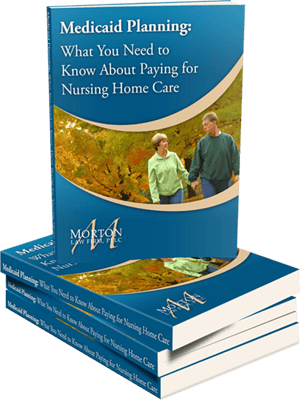
Get Your FREE Report Now!
Three Reports Tell Secrets to Paying for Nursing Home Care.
Simply enter your name and email to the right to get your 3 Free Reports that reveal little known secrets to qualifying for Medicaid without going broke.
Plus, receive the Morton Law Firm email newsletter and alerts to upcoming education events absolutely free!